Monday, April 23, 2012

SBMS Micro-Finance Videos


          Here are three video clips relating both to my recent trip to Bhutan with my dad and sister, and to a micro-finance class that my dad recently taught the 6th and 7th grade classes at Santa Barbara Middle School.


          The first clip is from the trip we just took, and focuses on;  the day we spent at two schools in Paro, revisiting with students we first met three years ago;  a moment in time with Buddhist pilgrims worshiping at the National Memorial Chorten of Bhutan in Thimphu;  and, the morning we spent with young monks at their monastery in the hills above Thimphu.


          The second clip is from my dad's class, and is the video that we played for the Bhutanese elementary school class in the first video (A Return to Bhutan, at 5:50).  In this clip, one of the Middle School classes has made a video of what a typical American classroom looks like, so the kids in Bhutan (who we were filming to show back home) could see the American class that would be seeing them.  They were fascinated by the video, asking to watch it again and again - their favorite part being the Google Earth maps on one of the kid's computers in Santa Barbara.


          The final clip is also from my dad's class and is a composite of some of the classrooms that my family has visited all around the world - it was the lead-in piece to help explain why and how my family became involved in micro-finance in the first place.  It has segments from our first visit to Bhutan in 2009, including the vocational school for deaf students, the elementary school in Paro (both of which we just visited again), and, a school for young monks high in the Himalaya Mountains. (the Bhutan segment starts at 2:35)


[ADDED May 15, 2012] - Here's a local newspaper article about the class:

Santa Barbara Middle School Students Paying It Forward — Around the World

Parent Eric Sanborn shares a valuable lesson in micro-financing, with sixth- and seventh-graders 'investing' in business enterprises in poor countries
With the help of social studies teacher John Seigel-Boettner, Santa Barbara Middle School sixth- and seventh-graders utilize online resources to research people and businesses in need of financing in some of the world's poorest countries. The school's Sanborn family has generously given each student the minimum investment amount of $25.
With the help of social studies teacher John Seigel-Boettner, Santa Barbara Middle School sixth- and seventh-graders utilize online resources to research people and businesses in need of financing in some of the world’s poorest countries. The school’s Sanborn family has generously given each student the minimum investment amount of $25. (Santa Barbara Middle School photo)
By  | Published on 05.07.2012

Imagine at your family dinner table your conversation takes you traveling to all seven continents around the globe, and instead of booking a comfortable hotel alongside a stretch of white sandy beach on your next vacation, you opt to stay with Buddhists in Bhutan, celebrate your younger daughter’s birthday with Bedouin “terrorists,” or volunteer in the schoolhouses of the indigenous tribes in Africa. That is what Santa Barbara Middle School’s Sanborn family of five has chosen to do over the past 12 years.

Eric Sanborn, SBMS parent, recently shared some of these stories in his younger daughter’s class at Santa Barbara Middle School. His main reason for addressing sixth- and seventh-grade students was to share the success and enthusiasm his family has had loaning money to people in some of the world’s poorest countries. It’s not a new concept, but it is a rewarding one. It’s called micro-financing.

During the past seven years, the Sanborn family has helped finance loans to more than 2,500 individuals and their small businesses in more than 60 countries around the globe.

“We ‘lend’ money to people rather than ‘give’ money to a cause, so that the loan beneficiaries can build their businesses and prosper,” Sanborn said.

Nearly 99-percent of the loans made by the Sanborns have been repaid.

“It’s such a rewarding experience to reach out to people,” Sanborn said. “You can’t go to these places and not be changed; it leaves something in you.”

Currently, 60 SBMS students are trying this idea on for size in their own “pay-it-forward” experience. Lessons in micro-financing in John Seigel-Boettner’s sixth- and seventh-grade social studies classes, with help from Sanborn, are centered on Kiva.org, the Community Action Fund for Women in Africa and other micro-financing organizational models.

The students are learning about currency rates, interest rates, social obstacles to business development in Third World countries, and how to distinguish between charity and loans. The curriculum was designed to allow the young people to connect first with the outer journeys of the Sanborn family as they traveled the world. Then the students joined the more personal inner journey that the family took, which was mostly completed around the family’s dinner table. It was these dinnertime conversations that compelled them to “do something” for the people they had met and ultimately led them to micro-financing.

The Sanborns have generously given each student the minimum investment amount of $25 with the hope of teaching the students that their investment decisions have real-world application. Students choose from thousands of people and businesses in need of financing. Online Kiva.org provides a business description, photo, country of origin and spells out the repayment risk of each investment.

Seigel-Boettner is always trying to connect his students with other cultures throughout the world.

“The human connection is something I always try to do in my teaching,” he said. “The other half is to empower kids to be part of it. This unit is helping put a face and a name on the world.”

Seventh-grade student Alea Hyatt chose to invest in a woman from Ghana who sells fish for a living.

“Instead of saying we’re going to make a change, but end up not doing anything, we actually are changing lives by investing $25,” Hyatt said.

Seventh-grader Daniel Solomon chose a Colombian man who installs gas lines for his micro-loan. Solomon says this work makes him feel good about himself.

“You actually feel like you’re making a difference,” he said. “You get to change someone’s life.”
Another business investment is Deryn Gersoff’s loan to a women’s business consortium in Guatemala that makes sweatshirts, weaves baskets and raises animals. Like many of her fellow students, Gersoff has already received partial repayment.

“It’s hard to believe that there is actually someone on the other end, and when the money is repaid, this whole experience becomes more real,” Gersoff said.

“In social studies we learn ways to make a difference, but in this way we actually are making a difference,” seventh-grader Jaime Schuyler said with a smile.

That’s music to Seigel-Boettner’s ears. He hopes that when his students put their head on the pillow at night that they think about someone on the other side of the world. He says the final exam of this lesson plan comes seven or eight years later, when he receives a postcard from one of his former students saying, “I’ve started a soccer camp in Tanzania, or I am in Philadelphia at an inner-city school teaching children.”

Seigel-Boettner said he is always eager to know which lessons of his have made a real difference in the lives of his students.

Most every student says that once repaid they plan to reinvest with another new stranger or business venture somewhere else in the world. Sanborn is hopeful that the seeds he has planted will take hold, and the students will come out different on the other side of this experience.

“You can tell they have made a connection with the people they have loaned to,” Sanborn said, “and it’s that connection that is important.”


Wednesday, April 18, 2012

རྒྱལ་ཡོངས་དགའ་སྐྱིད་དཔལ་འཛོམས་ Gross National Happiness


          After our dramatic escape from the Himalayas’ icy clutches, we have enjoyed 2 full days in Bhutan’s capital, Thimphu. Some of the highlights have been hiking to monasteries, visiting craft shops, playing a game of soccer with Buddhist monks, and crashing the Prime Minister's party......but more on that later.


          Bhutan prides itself with the unique measurement of Gross National Happiness (GNH), and truly, we can find no shortage of happiness here. Everywhere we have been so far, we have been greeted with nothing but smiles and kind words from the locals. No matter how poor they might be, or whatever the job they hold, the people are just genuinely happy and welcoming. Examples abound – I’ve already detailed the farmer who welcomed us into her home to warm ourselves by the fire – and earlier today, we visited a monastery and school where young monks live and train from age 6 all the way to their late teens to become proficient monks. Now you might expect that everything there would be very rigid and dogmatic, but this is Bhutan. After their (very serious) morning studies of Buddhist scripts, the more athletically inclined monks regularly enjoy a game of soccer at lunch. Now we learned in Laos a few months ago that women and girls must not have any physical contact with monks (lest they impurify them with girl-cooties or something…), but this rule apparently doesn’t apply here in Bhutan if it’s soccer and you’ve got game....as after the monks watched Emily kick a ball around, we were both invited (challenged) to put together a team and play against the local “A team”.


          We chose our guide and four or five monks to round out our team and played an intense 30-minute game of soccer. Emily more than held her own, scoring three goals from the right wing and probably teaching the monks a few important lessons about girls as well. Overall, the game finished about tied with each team scoring about 8 or 9 goals. I would have thought that wearing a full set of robes, and sandals would have slowed them down a bit, but these guys have been playing like this for most of their lives. I hate to admit it, but with all the red robes and shaved heads, it was hard at first to remember which monks were on our team, but after a few minutes we could identify them by adornments (beaded necklace; double wrap-around belt; blue sandals, etc…) and all was well again. Only the older monks got to play in the match, the younger ones had to watch from the sideline, but we were told that sometimes they would steal the ball and run off with it to annoy the older guys – which was hilarious to me and Emily as it reminded us of things our younger sister would do to interrupt a game she didn’t like us playing.


          Before the game, we visited a classroom, where the first year students were supposed to be memorizing texts, but their teacher was in town for the day so after we showed up, the little monks had more fun talking and goofing around. Their ages ranged from about 9 down to a tiny 6-year-old. I also would have thought that they would be very peaceful and calm, but when they started asking questions, one of the first was if we watched WWE (World Wrestling league – the one where the wrestlers supposedly break chairs over their opponents heads, etc.). After that they all started telling us their favorite wrestlers and their favorite finishing moves, like the pile driver. When I think of Buddhist monks, I don’t expect them to start talking about pile drivers. My dad made the whole class scared (and then laugh hysterically) when he told them he knew the move and pretended to pick one of them up and “pile drive” them.


            Another memorable activity we did during our time in Thimphu was to sneak in to an event being attended by the prime minister of Bhutan and a number of other important ministers. Just 4 years ago, in 2008, the Kingdom of Bhutan transitioned from being an absolute monarchy, ruled only by the king, to a constitutional monarchy - so this first-to-be-elected prime minister, Lyonchoen Jigme Y. Thinly, is a very important man. In most countries, we probably would have been arrested or shot at for the way we got in to the party - but, again, not in Bhutan, where there was no suspicion for our intensions, and our entry into the party was treated by the police more as a puzzle to be solved and less a crime to be stopped. The event was a ceremony dedicating a statue of the Buddha, which was a gift from a group of Thai Buddhists. We first walked to the main (and only) entrance, and our guide asked the police if we could go in, he was told that we couldn't go that way because we were not official guests, but the policeman left our guide with the impression that perhaps there was an “unofficial entrance” for unofficial guests, if only we were to look for one.... So, we passed through some barriers and started walking around to another side,  climbed a small hill, and walked through the park where the event was being held. There were a number of armed police patrolling the obviously closed park, but each one we passed didn't stop us – instead, they would each suggest the best direction by motioning with their head. We eventually ended up “backstage” with a group of performers who were about to dance at the event and we went around barricades at their entrance, through the back of a tent, and were finally in the event area. In most events like this, attendees would have been shocked that people came in uninvited, and would have made us leave. But here no one said anything about that, and instead told us the best spots to film the dancing and other performances. Eventually, we relaxed about breaking-in to the event and by it’s end, we were up on stage dancing with the prime minister and all the other distinguished guests. We were courteous enough to make our departure just as Bhutanese officials started presenting all the guests with elaborate gifts of appreciation (for the 40-foot tall statue of the Buddha being dedicated). When I came to Bhutan, I was hoping to meet the King, but the Prime Minister will have to do!

the Prime Minister of Bhutan (back left)

            A final thought for this blog entry is that even though Bhutan would be classified as a very poor country, it nonetheless is very dedicated to its people and the land. Nearly everywhere we’ve been here, there have been trashcans and signs saying to save the environment and to recycle. There are forestry laws that are actively enforced, and because of this they have 70% of their land covered with forest (in stark contrast to the similarly located country of Nepal, which used to be heavily forested, but where now, according to the World Wildlife Fund, only 29% of the forest-cover remains). They have a free education system that is effective and is available to all. They have plans to connect every house in Bhutan to the power grid, and to generate all their electricity by hydropower in the next five years. Their King is also very dedicated to the people, and regularly heads out to even remote villages to talk to the locals and fix their problems. When the massively destructive earthquake hit the country last year, the government stepped in and is paying everyone who had damage to help cover the cost of reconstruction.

Emily looks over Thimphu valley (and Thimphu Dzong) during one of our day-hikes in the hills

          In short, Bhutan may be just a small, peaceful little kingdom in the mountains, but it’s got more happiness then just about anywhere else on our planet.  


Saturday, April 14, 2012

The Druk Path - aka, Escape From Druk Mountain


          On Sunday, after a great day-and-a-half catching up with our friend Mr. Tashi and visiting his sister’s school, it was time for our trekking adventure to start, and we set out for what we thought was going to be 5 days of fun in the mountains... But little did we know what challenges were waiting for us in the foothills of the Himalayas.


Me, with Mule Team Six in the background....
          Things started out well enough as we began our hike up and out of the town of Paro, bound for the capital city of Thimpu on a popular trekking route named The Druk Path. Our initial elevation was about 7,500 feet, and our camp for that night was at around 11,500 (with lots of up-and-down along the way), so we had quite a bit of climbing to do. It’s amazing just how thin the air is up at 10k+ feet, and we were all slowed down significantly each time we began a new uphill push. Just before we stopped for lunch, we passed a group of American trekkers, and we talked to them for a few minutes about the hike. They told us they were turned around after 2 days because of a blizzard at the 3rd camp. This was our first warning of what was to come, but on the word of our mountain guide, we decided to proceed forward and assume that by the time we got to camp 3, the snow would be mostly cleared by spring temperatures.


Our first view of Camp 1


          There were 4 other groups that started the trek the same day we did. Among them were a French, a British, an Indian and a Swiss group (or individuals) all of which would be attempting a trek similar to ours. After our first day on the trail, we arrived at Camp 1, located in a field a few hundred feet below a small monastery.  Our camp was pretty luxurious compared with most camping trips I’ve been on. We had 2 sleeping tents, an eating/ sitting tent, a cooking tent, and to round it off a little bathroom tent. Along with us were a cook and his assistant, 2 horsemen, and our guide. Carrying the bulk of our gear and supplies was our loyal team of seven horses and mules.


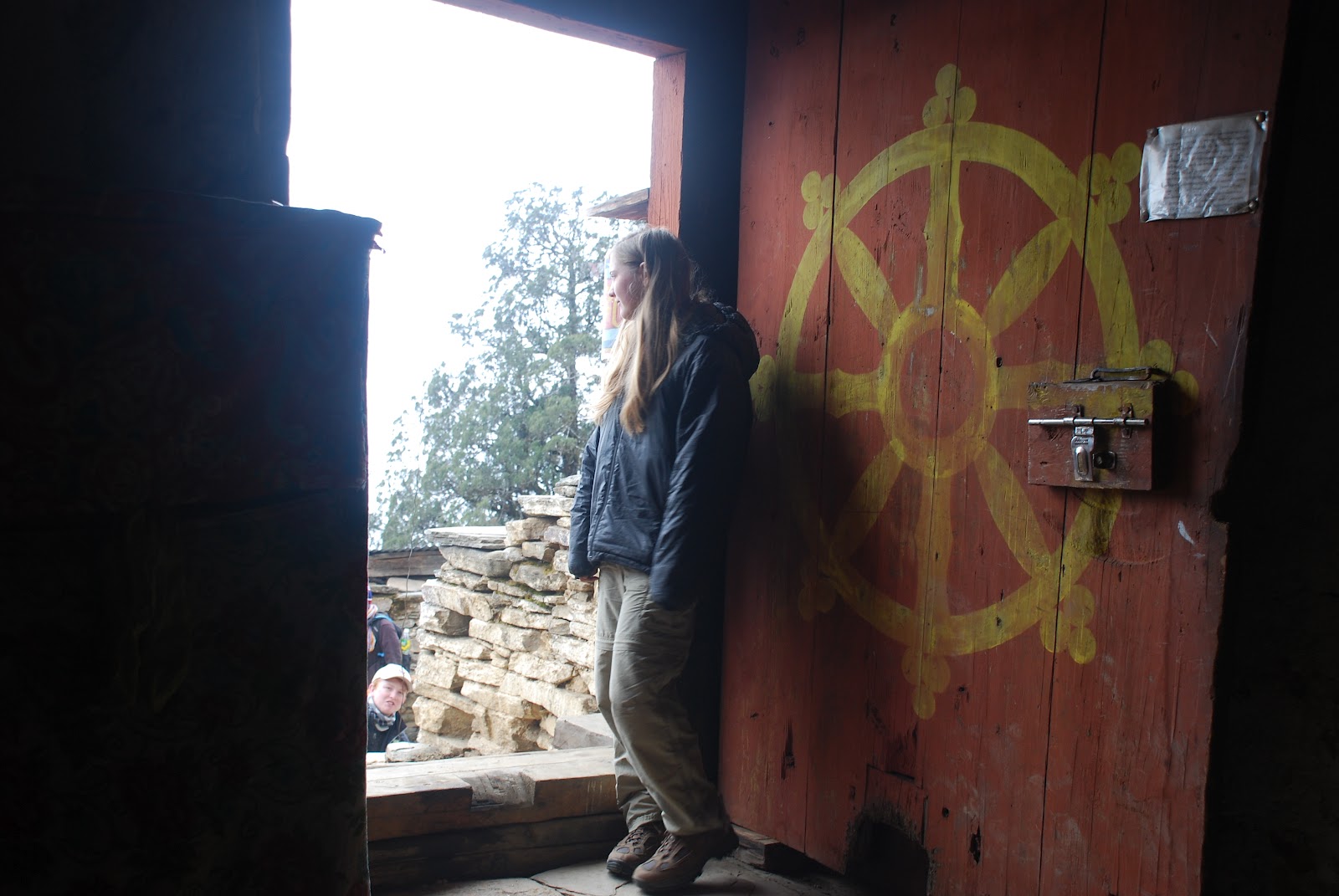
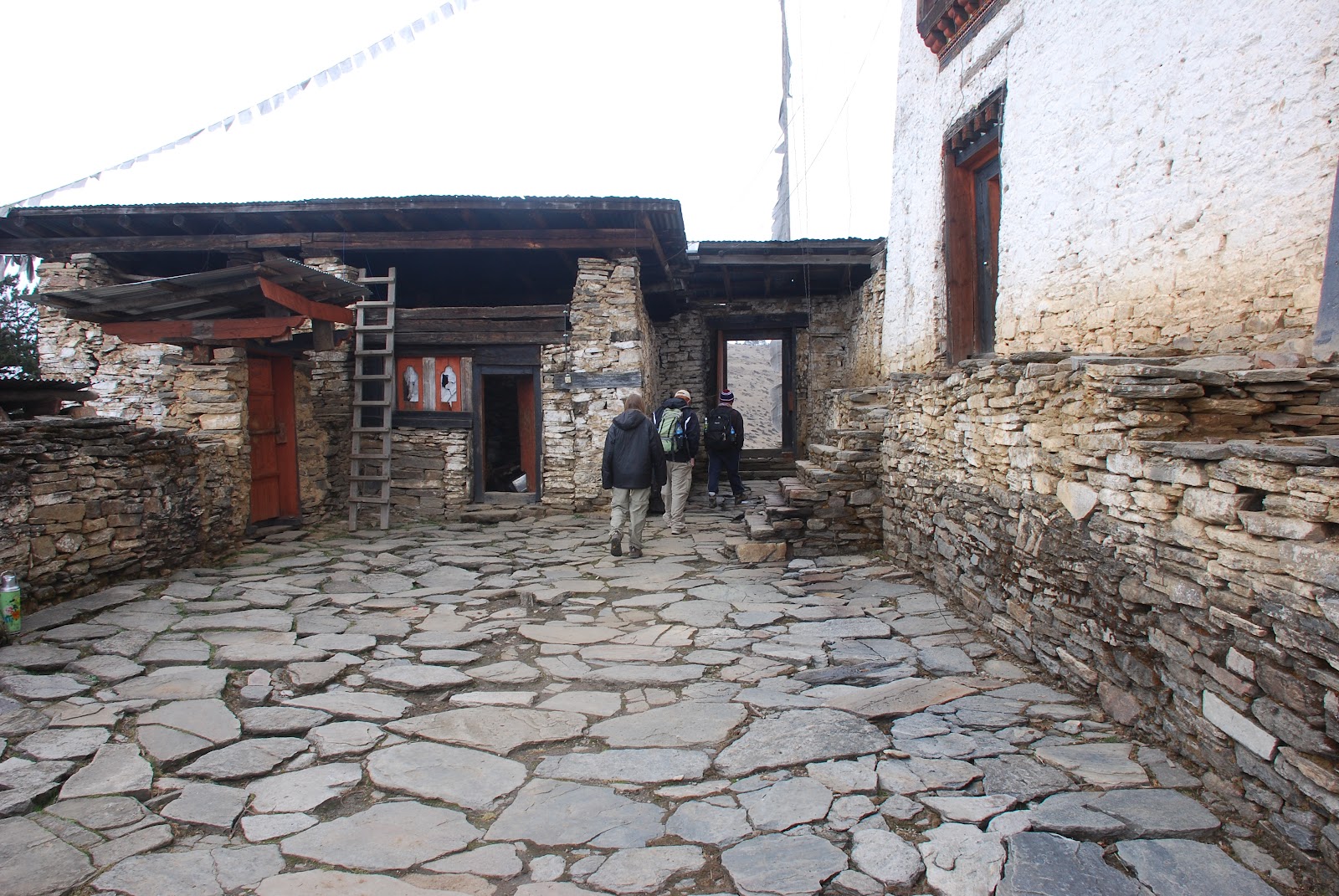
          The first night was fairly cold, likely below freezing, but nothing we couldn't handle. However, warning #2 came the next morning when we learned that 2 of the other 4 groups had jumped ship and were turning around. Now we were down to 3 teams. We started out the day with a quick climb to the ridgeline above us, where we visited the monastery up there. It had sustained damage during the big earthquake last year, so our visit was short, but still, the views were spectacular. For the next few hours, we hiked along the ridge, averaging around 12,500 feet. The scenery was beautiful. We hiked though huge pine and juniper forests, and it felt like we were in the Sierras or Rocky mountains. About ¾ of the way to camp 2, we came across a group of Italian hikers who appeared to be very fit. They were heading in the opposite direction from us and their guide told us that they had come across about 2 feet of snow on their way to the 3rd campsite (at an elevation close to 14,000) and were forced to turn back and skirt around the mountains at a much lower altitude – warning #3.


          At this point, we became a little hesitant about what we should do, but continued on to the 2nd campsite to make a decision there. Just before we arrived at camp, we hit the snow line on the ground from the blizzard a few days before. It wasn't fully covering the ground, but nevertheless it was there. Just as we arrived at camp, it began to rain. The horsemen had arrived before us, so we were thankful to be able to immediately take cover in our tents. As night fell, so did the temperature, and rapidly. Soon after the rain started, it turned to hail, and by dinnertime, it was snow. It was really cold in the tent that night. Every time I moved around I would shift away from the warm part of the sleeping bag, and it was freezing. I was really tired, so eventually I was able to drift into a cold, but welcome, sleep.


          It snowed practically the entire night. When I woke up the next morning, I found myself in a winter wonderland. The mountains and trees were covered in snow, but the dirt campsite was mostly clear of accumulated snow.  At this point we knew it wasn't a good idea to continue the trek – certainly not up to 14,000 feet as the snowfall appeared to be in full force in the mountains just above us. As much we didn't want to accept defeat, we just weren’t prepared for sustained snow. I didn't have gloves or a warm hat. So we plotted our next move. Originally we planned to hike down a 7-8 hour escape route to the nearest spot a car could pick us up, but then our cook came to the rescue, as he knew a shortcut that would only take us around 4-5 hours. It was a steep and muddy descent, but we were grateful for the shortcut. After two hours hiking steadily down, we reached the first sign of civilization as we could see a rural farmhouse far below us in a steep valley. But, before we could reach the farmhouse and enter the valley, it began to rain heavily. After another hour or so in the rain, we reached the farmhouse and were pleasantly surprised to be welcomed shelter by the family living there. We were invited in to sit by the fire and warm up while it was raining. During this time we had lunch, and we struggled with intermittent cell phone coverage as we attempted to contact the car that would (hopefully) meet us at the nearest road a few more hours hike down the valley. The farm currently had just two residents, a mother and her youngest son. She had 5 children, but the rest had married and moved to Thimphu (she didn’t mention having a husband, so we presumed he had passed away). They were nomadic herders, and only live in the house during the wintertime. The rest of the year they are up with their animals – eighty yaks - in the high mountains. Their house had been damaged during the recent earthquake, and still needed repairing. So in the meantime they live in a smaller house built next door.  We were very grateful for their hospitality, and wished we could have stayed longer, but we needed to find the car and get to Thimphu. During a break in the rain, the son showed us the way along an extremely muddy and treacherous path that traveled along side a creek. Eventually, we made it to the end of a logging road that had only been completed a year before, but then found out the car had driven up the wrong side of the canyon, and would take at least another hour to reach us – but at least we knew that someone was there. We continued walking down a little ways to keep warm and to kill some time, and eventually we saw the car turn the corner, and knew we had made it! We were happy to have gotten out safely, but lets take a minute to think about the remaining 2 groups, who last we heard are still out there, up at around 13,000 feet.

A welcome respite from the cold and rain


We improvised much of our flight down the mountain on the last day


Himalaya, a poem


The Trekker
The rain poured hard onto the high emerald forest
Tucked into the far reaches of an untraveled valley in the foothills of the Himalayas
A traveler appeared through the trees, wrapped from head to toe, soaked
Pure exhaustion plastered on his face, after days of wandering the snowy, unforgiving landscape
A farmer stood there to greet him, a sympathetic look on her weathered face
An invitation to sit by the fire, some simple words and smiles exchanged broke the barrier between two foreign cultures


Wednesday, April 11, 2012

In the Land of the Thunder Dragon


         It has been exactly 3 years since I’ve been to Bhutan. My first visit was with my whole family during the spring break of 2009. While we were here, we visited many of the famous sites, we made many connections with the people of Bhutan, and we all felt there was much more that we should see and do here, and that this was a place we would like to come back to one day. Now, during my current break from school, three of the five of us have returned. I'm with my dad and sister Emily, as my mom and sister Claira had to stay back in California for work and school. Since we’ve already seen many of the tourist sites during our first time in Bhutan, this trip is more about revisiting the sites that were important to us, reconnecting with people we met last time, and, most importantly, getting out into the high Himalaya Mountains as we'll be taking a 5-day trek along the "Druk path" between the historically important town of Paro and the capital city of Thimphu.


Lucky Emily went diving in Thailand during the first week of her break
            I am writing this on Saturday night, tomorrow we start the trek, but I didn't just appear here, there was a lot the happened the last few days. On Friday the 6th, I flew down to Bangkok on Qatar airways, which was quite fancy, and landed just after dark. My dad and sister had been off the coast of Thailand in the Andaman Sea for the past several days on a scuba-diving cruise (Emily had a two week break from school, whereas I have just one). They arrived about an hour earlier, so it was up to me to negotiate my way though Thai Customs. Luckily, Americans don't need Visas, so the process was pretty painless. I met up with my dad and sister at the airport hotel, and we went to bed pretty soon after, because our flight to Bhutan was at 4:45 am.


An unusual view of an airport runway....
            Waking up at 3am the next morning was painful, but we were all exited to be heading to the Himalayas. By the time we checked in, cleared security and customs, it became apparent that we were the last ones to arrive at the gate. After being escorted by an airport employee down a few levels to what should be the bus loading station, we saw instead there was a van. There was only one other person in the van. So I like to think that we got the VIP treatment. We weren’t necessarily late, I mean, we boarded the plane at 4:20, that's plenty of time! Soon enough, we were in the air and on our way to one of the most dangerous airports in the world. Drukair, the national carrier of Bhutan, is the only airline that flies into Bhutan, and they only have two (very busy) airplanes, both airbus A-319s. Landing at Paro airport isn’t for the novice or faint of heart. There are less than a dozen pilots certified to land there. The descent is visual flight-rules only and involves landing in a valley surrounded on 4 sides by mountains that exceed 11,000 ft. First the pilot must make a few hairpin turns to enter and follow the valley, at points coming so close to the mountainside that I probably could pick some leaves if there wasn't a glass window. Then the must fly straight over downtown Paro at about 500 feet, before making one final turn to line up with the runway. It’s a pretty terrifying experience, but really exciting at the same time. Check out this video of the last couple turns before landing (on a clear and calm day!).


            After being greeted by our guide, and getting a few hours rest, we started our activities for the day. Also joining us for the day was our Mr. Tashi, who was our guide back in 2009, and his wife. He has retired from guiding, and now manages one of the fanciest hotels in Thimphu. We’ll get to stay there in a few days, after the trek. We were also joined by his sister, who is a teacher at a local school. The highlight for the day was revisiting a school that we went to back in '09. They operate a school for the deaf on the campus, and we brought videos of our past visit with us to show them. They were very happy to see us, and quite a few remembered us from last time. One even remembered that I referee soccer! They were so happy to see the videos, and see themselves 3 years in the past. One of the deaf students we saw last time has since graduated and now teaches at the school himself. They have a great program there, where they learn sign language, various trades that will help to make them productive members of society, as well as writing in the local language and in English. Most of the conversations we had with them had to translated from sign language to English by the teacher, but one of the older students was able to have an entire conversation with us in written English! Many of them wanted to demonstrate some of their vocational training for us, as they are skilled artisans in woodworking, sculpting, and decorative arts. It’s great to see programs like this, because in most of the world, disabled kids are often denied an education and shunned, but here they have a great program that teaches them skills that they will be able to use the rest of their lives.


(I'll add a video of the school day here, when I get home)

            Next, we went down a small hill to the rest of the school. It was Saturday, so they were in the middle of their service time. All the students were working around the school planting in the garden, building stairs, repairing paths, you name it. We had the distinct honor of being the first ones to use a staircase built by the 5th graders. There were no classes going on, but the assistant principal, who was guiding us around, invited us to visit any classrooms that we wanted to see - and shortly after we entered an empty math classroom, before I knew what was going on, we had an audience of 60 6th and 7th graders. That's not counting the ones looking in from the windows on either side. There were many students there that remembered us from our last visit, and the asked where my mom and sister were. My dad went to back of the room to film, leaving me and Emily run the class and we began by fielding questions from the students. We got a lot of basic ones, like, What’s your name? How old are you? Where are you from? I was really impressed with their English; they all seemed very good at it. My family has visited many classrooms all over the world, and it doesn't matter where you are; Africa, Asia, America, there’s always the one little punk who wants you do something embarrassing. Of course it’s never malicious or anything, and it’s all in good fun, but it doesn't matter where you are, and Bhutan is no exception. So after a few basic questions, one of the guys raising his hand, and asks, “sir, can you sing us an American song?” I obliged him, and sang a rendition of Itsy bitsy spider so well, not only will it earn me a Grammy, but it also won a standing ovation from the class. Now it was my turn, I shot back at him “Ok, I sang my song, your turn! Sing me a Bhutanese song” He said “Oh, I can’t, I’m not a good singer!” I replied, “That makes two of us, but you have to!”. He then told me his friend sitting next to him could sing very well and pushed him up. And he wasn't lying, he sang a Bhutanese song, and it was awesome. Next, my dad showed them a video (on his iPad) that a class from Santa Barbara Middle School had made to show to them what a classroom in the United States looks like. Since my dad had showed them a video of the Bhutanese class from 3 years ago (along with many others we have visited), the kids at Middle School, knowing we were going to Bhutan, wanted to make one to show to the Bhutanese students. Even though there were many students in the class, and the screen was small, they loved it! At some point soon, I'll add the videos to this blog.


After we left the school, we had lunch in town, and visited a few temples. Then we returned to the hotel and after dinner will soon go to bed. I have been awake since 3 am, so I am ready for sleep. We have a big day ahead of us tomorrow, when we begin our trek. I’ll be off the grid for the next 6 days, so I’m sorry there will be a little gap in entries, but then again by the time you read this, the gap will be closed.


Wednesday, April 4, 2012

(In)Tolerable Loss?

There it was, as we turned the bend, through the fog we could see the twisted and scrunched up remains of what had been, only a few minutes before, cars and trucks. One of the cars had collapsed into the back of a large container truck, another had simply swerved off and had been abruptly stopped by the hillside which hugged the narrow mountain road. Then there was the fuel truck. It jack-knifed and swerved the other way, towards the precipice of a giant cliff. It couldn't have stopped more then a few feet from the deadly drop off. It was absolutely incredible. As we drove through the scene, people milled about, one of the truck drivers was bleeding from the head. A group of motorists had stopped and were helping get people out of the cars. I was traveling with my school group and we were on a trip through a mountainous region of Vietnam, and, as there seemed to be little we could do, our driver continued on, back into the fog.

            Unfortunately for the accident victims, the ambulances probably didn't arrive for a long time. We were high in the northern mountains, and if it takes an hour for the fire department to arrive in the city, it's hard to even guess how long one in the countryside takes. That is a major problem right now in Vietnam. Their emergency response right now is just completely unacceptable. The country is developing at such a rapid pace, and yet it lacks way behind on issues such as the wellbeing of the people.

Our driver's view as we make our way along the busy road
            The road we were on also says a lot about development in the country. It was built many years ago to support light car traffic, but is now heavily used by all kinds of vehicles, be it trucks, cars, motorbikes, actual bikes, farm equipment....basically anything that can roll is out there. If I thought the safety conditions in the cities were bad, the driving in the countryside is simply unbelievable. There are no seatbelt laws (or there could be, but either way no one cares), the people rarely wear helmets on motorbikes, and cars and trucks drive as if they are in a street race. The average speed at which motorists are drive at is absolutely crazy. Being out on these roads in low visibility conditions, the people in our van were getting nervous, and I don't blame them, I was too. Add to that driving on a high, windy mountain road, with flimsy little guardrails, and with semi-trucks and busses regularly passing on blind corners....and it’s really no mystery at all that people die up here all the time. If anything, I was surprised we didn't see more accidents.  
That is one lucky trucker right there

          So, of course now the question is, how can the road become safer? Well there isn’t a one-size-fits-all solution to this problem. A lot of things need to change. People need to become more aware while driving, and realize that a helmet, or seat belt, might actually help them. The government needs to look more at distributing more of the wealth outside of the major cities, and improving dangerous roads like this one. Only then can progress be made to make transportation safer in the countryside.


          I recently discussed this issue with my (real) dad, and he told me about the concept of acceptable loss.  That is, a society will tolerate a certain amount of loss - road accidents with fatalities in this case - but eventually a tipping point is reached where the loss becomes unacceptable and the society will then spend the necessary money and enforce the necessary rules to mitigate the loss. An example in the US would be that in the 1970s, road fatalities were significantly higher per capita than they are now (like double!), but that number eventually became high enough that it was intolerable to American society, so we introduced (and enforced) seatbelt requirements, lower speed limits, and safer car standards to bring down the number of road fatalities.


          I wonder what it will take to effect similar change in Vietnamese society.

Saturday, March 31, 2012

School Year Abroad Vietnam: The End of an Era


It’s not often that one can say that they were in the final class of school. But unfortunately, today I can say that. It is with great sadness that I must report to you, my readers, that School Year Abroad Vietnam will not be continuing next fall. It came to a vote this past weekend by the board of directors back in the States, and it was decided not to continue. I was given the news this morning in a meeting by our director Thay Vuong. The mood was understandably strange for the remainder of the day. Our class actually spent a good hour and a half in the morning discussing it. We of course are very against the shut down. We believe that it’s unfair to cancel the program after only 3 years. Like with anything, the first few years are always the hardest, but most of the time, after grinding through, it gets better. Of course the first 3 years of the program have been trying, but what about when they get to year 6? Well, I guess we’ll never know.

Having had the extraordinary opportunity to come to Vietnam has helped me grow so much as a person, and I think it’s a shame that others won’t be able to experience what I have, a real shame. I have learned so much about how to live and adapt to a strange new way of living, and it will help me so much in the future. When ever I feel like the going gets tough, I can always look back on my time here and say “ I lived in Vietnam for 9 months, I can do this!”.  Just looking back at myself before I came here, and who I am now, I can hardly recognize my self. Sure, I still have my famous fiery red hair, but inside I feel completely changed. This program has benefited me so much, and I know that next year’s batch would have experienced those exact same changes, and would have left Vietnam a better person because of it. There have definitely been hard times this year, I won’t deny it, but the final result is what counts at the end of the day.

I also feel very bad for my host family. Because when it comes right down to it, even though the program is being cancelled, I still got to do it. But they were so looking forward to hosting many more young SYAers like myself, and it’s such a pity they won’t be able to have an opportunity like this again. They are so loving and caring, and would have made next year’s host kid so happy, just like they did for me. I am just so lucky to have been paired with them, and I can’t imagine being with any other family.

The hardest part, and what saddens me the most is thinking about the things that could have been. This was an amazing experience that was offered to me, and I only wish that others could have been offered it as well. I respectfully disagree with the board’s decision to end the program. I think that a few more years should have been allowed to see how the program developed. There is such an incredible group of teachers and parents over here, who would have made such a massive impact in the next group of juniors and seniors lives. This program was such a great one. To have the opportunity to travel to a developing country like Vietnam as a junior in high school is almost unheard of, most would have to wait at least until until college for an something like that. So in the end, is there anything that can be done to save the program? Probably not, but what I can do is be thankful that I was able to attend this program, and learn and grow for a year in Hanoi, Vietnam.


Friday, March 30, 2012

Hà Nội is Burning


           I startled awake to the sounds of people yelling! As I slowly opened my eyes, I noticed the orange light leaking trough my window. I looked at my watch, it was 4:45am, but why was the sun rising? After my initial shock waking up, I realized what was really going on: Fire! I rushed to my 4th story window, and the scene below me was one of chaos. In the dim, pale light of a street lamp and the ominous glow of orange reflecting off of walls, I saw people rushing around below me. On the roofs next to the building on fire, men were dropping buckets of water on top of it, to try and quell the flames. Their efforts, valiant as they were, just weren’t going to cut it, though. We needed the fire department. In that instant, I remembered something. I have been living here in Hanoi for around 7 months now, and in that entire time, I have seen 1 fire truck. 1. In a city of around 2.5 million, I have only seen 1 fire truck. At around 5:15, with the fire still raging, it became apparent that they weren’t coming any time soon. As the sun began to rise, I was able to see the alley more clearly. A small crowd had gathered to witness the now fully burning building. There really wasn't anything they could do at this point. Then, at 5:40, about an hour after the spectacle had begun, the cavalry arrived. At first it was a distant siren that soon came closer and closer. Then, our brave (and very late) heroes came running down the alley with a long hose in tow. The crowd stepped back to let them through. Then, all of a sudden, everyone began scattering and running away from the house (from my window I couldn't see the front). I nearly had a heart attack because for a second I though the building was coming down! Thankfully tough, it turned out to be just a misdirected fire hose. As it started up, I suppose it was accidently aimed at the crowd of on-lookers. For the next 20 minutes or so, the firefighters worked to control the burn. By 6, the fire seemed mostly under control. I could no longer see smoke. Remembering that I had to leave for school in about an hour, I got back into bed, and rested for half an hour, thinking about what I had just witnessed.


            It took the Hanoi fire department nearly an HOUR to get to the scene of the emergency. Think about how long an hour is during an emergency, especially a fire. Think about how much happens in that hour. If there had been people trapped in the top floors, not only would they have died, but they would have been dead for a long time by the time the firefighters got there. In the US, it would be outrageous to wait 10 minutes for a fire truck to arrive at the scene of a major fire, let alone an hour. If that happened in the US, it would probably make the news! Also, it was 5 in the morning. There is no traffic at 5 in the morning. Had this happened at 8 am, they’d probably still be on their way. There is actually a staggeringly high rate of people who die on route to the hospital in ambulances here because of traffic in Hanoi. But that's a different story for a different day. After seeing this, it really is no surprise that the traffic fatality rate is so high here, when it takes first responders an hour to get somewhere, that's about 50 minutes too late.


Sunday, March 18, 2012

Huế Cool

First of all, I should probably mention that the pronunciation of the Vietnamese city of Huế is, "way", otherwise you will have a hard time understanding all the bad puns I plan to include in the entry (including the title, above).


          Congratulations, you made it to part three of SYA’s central Vietnam adventure! I had never been to Huế, so I had no idea what to expect. But given the limited history I knew about the city (as an American), I have to say that I was pleasantly surprised. Huế is a very beautiful city, with its centerpiece being the famous Citadel.


          When many older Americans think of the city, no doubt one of their first thoughts will be of the infamous Battle of Huế, which took place during the Vietnam War in 1968, and was one of the longest and bloodiest battles of the entire war. In a sentence or two....the large, strategic bases established by the Americans in Huế in the mid-60s were not particularly well defended, and were quickly overrun along with most of the city by North Vietnamese forces during the country-wide Tet Offensive of 1968. In the month-long battle to retake the city, American forces suffered 700 dead and close to 4000 wounded soldiers, North Vietnamese forces lost 5000 to 8000 soldiers, at least 5000 civilians were killed in the fighting, and 80% of the city was entirely destroyed. It is perhaps the worst single battle fought by America at any time since WWII, and its horrors were depicted in the classic movie Full Metal Jacket. The psychological impact of having fought this (winning) battle, along with the Tet Offensive as a whole, is said to have turned public opinion in America against the war in Vietnam.


"For it seems now more certain than ever that the bloody experience of Vietnam is to end in a stalemate. This summer’s almost certain standoff will either end in real give-and-take negotiations or terrible escalation; and for every means we have to escalate, the enemy can match us, and that applies to invasion of the North, the use of nuclear weapons, or the mere commitment of one hundred, or two hundred, or three hundred thousand more American troops to the battle. And with each escalation, the world comes closer to the brink of cosmic disaster." 
- Walter Cronkite, CBS Evening News Anchor, in 1968, on the Tet Offensive and the Battle of Huế


          Thankfully, Huế definitely no longer looks like it did in the movies or newsreels. The people have recovered and rebuilt their beautiful city.


recreating famous war photographs.....


oohmm, shama lama...
            We spent our first day in the city biking with a guide to the Citadel, and took a tour around it. The Citadel is a scaled down re-creation of the Forbidden City in Beijing, although it is much smaller now than when it was first built in the early 1800s because of damage from the war and such. After looking around the museum, we got back on the bikes and continued around the city. Biking in a group like that brought me back to my middle school days (minus the helmet and safety guidelines....). Notwithstanding the countless bicycle  safety violations, we all made it back to the hotel more or less intact.


            Next up, we spent a full day at an orphanage in the city. The center not only takes in orphans, but also children from poor families who are unable to take care of them and can’t send them to school. Throughout the day we had a lot of fun playing games with the kids. We had a pretty intense game of soccer going on for about an hour, and I have to say team America did pretty well for a while. We had the opening goal, but it went down hill from there, and by the time of our inevitable surrender, I think it was more like 1-8, in favor of team Vietnam. We also had a full on arts and crafts station set up courtesy of Sarah, who brought in beads, string, and other miscellaneous things for the children to play with. In the afternoon, it began to rain, so we took in indoors, and played games until it was time for dinner - for which, we had a cookout. We made the kids hotdogs, ribs, and chicken. We didn't skimp on anything, and came fully prepared with buns, sauces, drinks and ketchup. By the time the day was done, everyone was full and happy, and we said goodbye to our new friends.


Teacher for a Day  (moment)


          It looks like that’s all I've got for this blog, as I already told you what happened on our third day in Huế, so I’ll spare you and not tell it again. For those of you who haven’t read about it yet, please scroll down below.


          Well, Da Nang it! As Hanoi-ing as it is, there is just no Huế we could stay here any longer. We needed to get back to school, and grind out another 3 weeks, before diving head first into the tropical jungles of interior Vietnam. I've heard word that Colonel Walter E. Kurtz might still be holding out there - expect a full video for that trip!